From Complex Gas Mixtures to Chemical Fingerprints: How LIG Sensors Work
See how multi-channel LIG sensors capture complex gas responses and structure them as comparable chemical fingerprint data.

Gases and odors are invisible, but they can provide important clues about the condition of products and spaces. A shift in the air, a change in a storage environment, or an unfamiliar chemical signal near a machine can all appear as changes in gas and odor patterns.
For a product to use those changes, however, sensory impressions need to become data that can be measured and compared repeatedly. NeuroSense uses multi-channel gas sensors based on laser-induced graphene, or LIG, as a starting point for that process.
In this article, a chemical fingerprint means a comparable pattern formed from the relative and time-dependent responses of multiple sensor channels. It is not a complete composition analysis of a gas mixture or a definitive identification of a specific substance.
Why real air is difficult to describe with one number
Air in real environments is a mixture in which many chemical substances coexist. Even the same odor can produce a different sensor response depending on concentration, background air, humidity, temperature, and airflow.
That is why a single number at one moment is rarely enough. We need to consider how strongly multiple channels respond, how quickly those responses rise and recover, and how the channels differ from one another. This combination preserves chemical context that a single total value can easily lose.
LIG creates a porous sensing structure
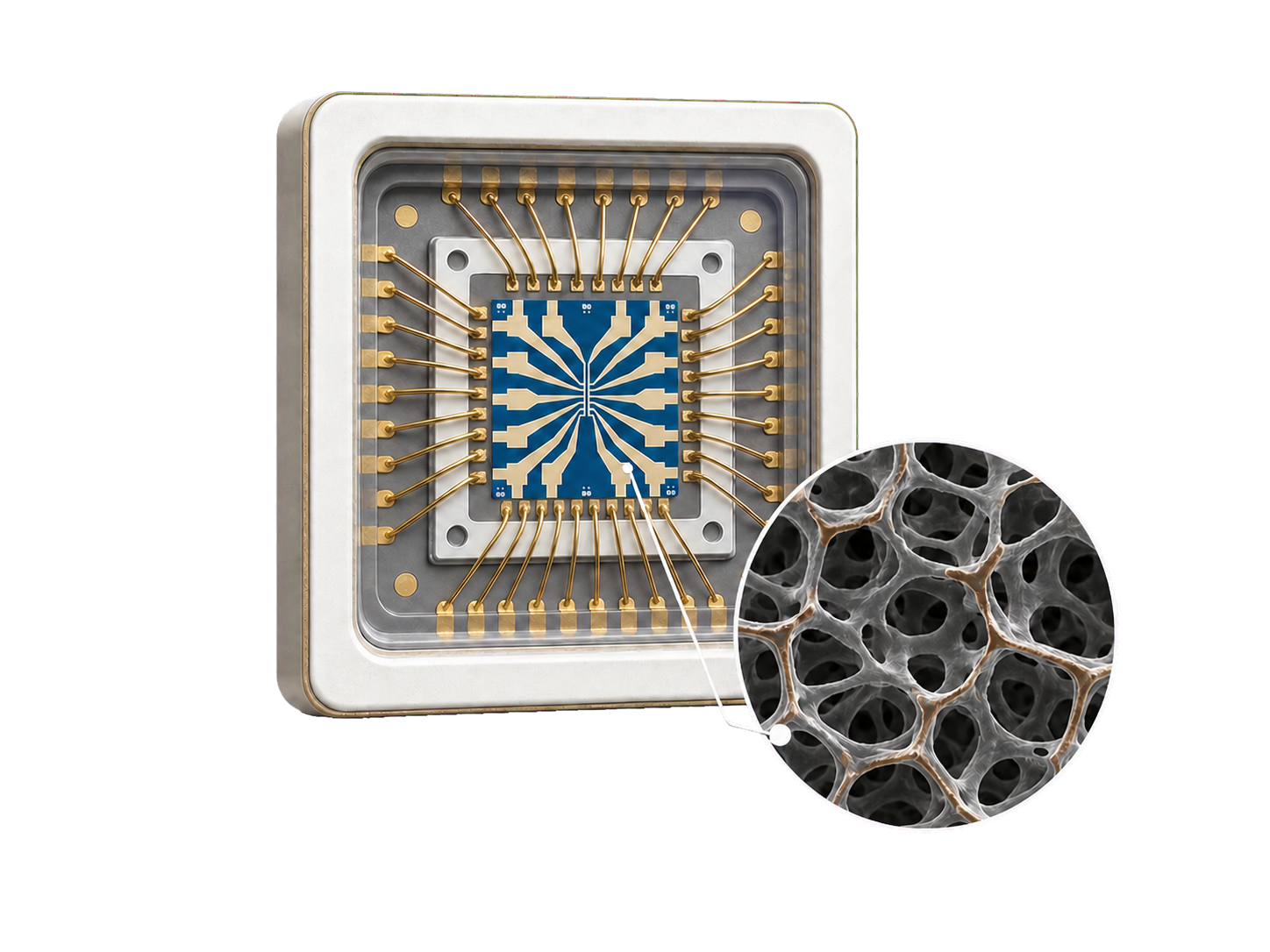
LIG stands for laser-induced graphene. When laser energy is applied to a carbon-containing material, it can form a porous conductive structure at the surface. Early LIG research demonstrated a method for directly forming three-dimensional porous graphene networks on polymer films with a CO₂ laser. Read the original work in Nature Communications.
A porous structure provides a large surface on which gases can interact. Different channel and sensing-material configurations can then produce different electrical responses. LIG itself does not immediately reveal the name of a gas; the hardware is better understood as the first layer that receives invisible chemical changes as a set of electrical signals.
Differences across channels become a pattern
In a multi-channel sensor array, each channel can react with a different magnitude and shape even under the same conditions. Looking at those movements together, rather than relying on one channel, creates a pattern that represents the measured condition.
Related research has shown that porous LIG sensor arrays combined with functional materials can produce distinct response combinations for different odor molecules and classify them with machine learning. Those results belong to the specific materials, experimental conditions, and training data used in that study; they do not directly establish the performance of another sensor. See the study in ACS Nano.
From response curves to chemical fingerprints
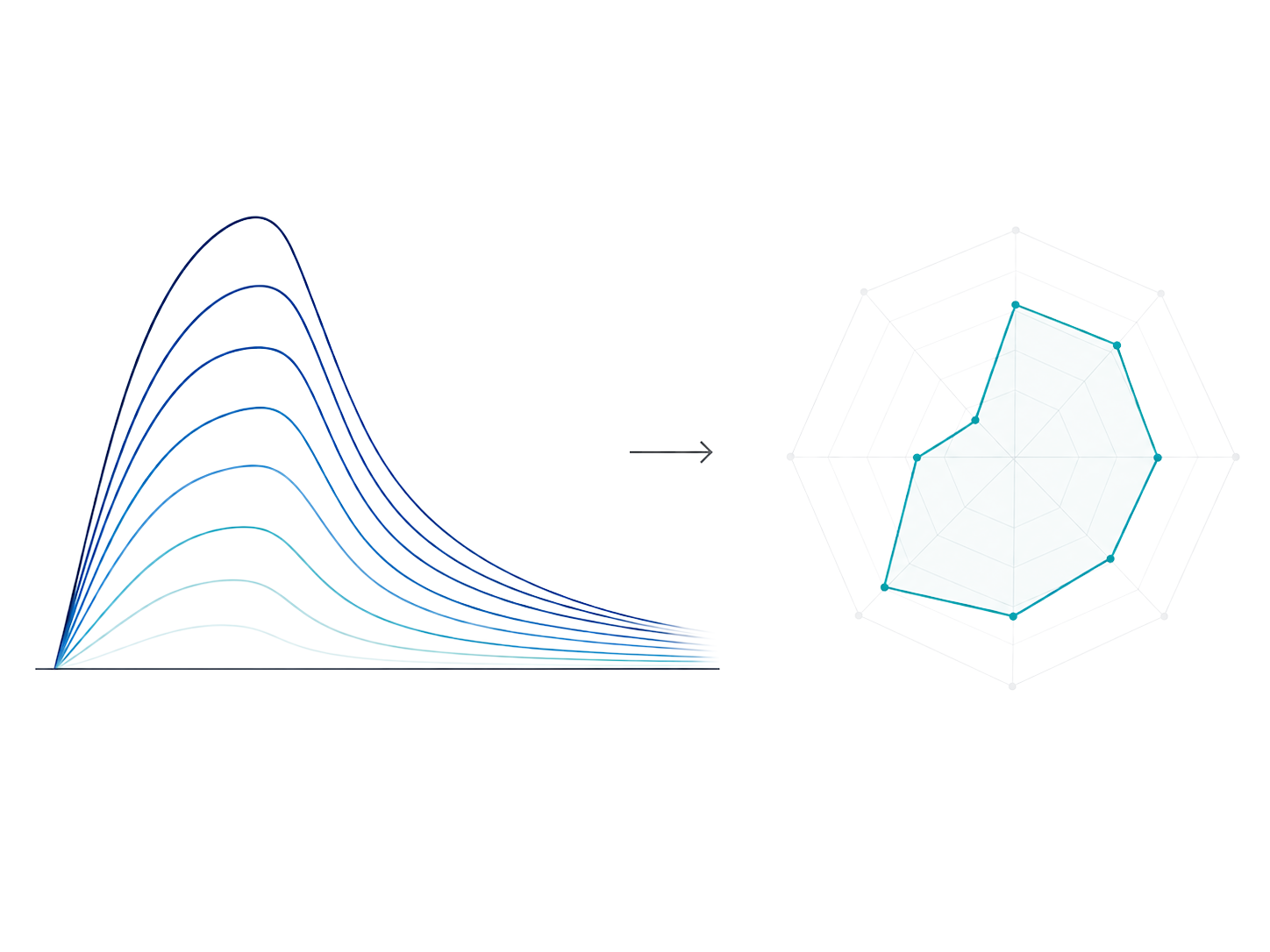
Raw sensor responses are difficult to compare across measurement times and devices. The signals therefore need preprocessing that accounts for baselines, response magnitude, environmental conditions, and differences between channels.
Useful signal features can include:
- How far the signal moves from its baseline
- How quickly the response rises or recovers
- Which channels respond more strongly than others
- Whether similar conditions produce repeatable patterns
When these features are expressed as a vector, radar plot, or heat map, responses from different moments can be compared using a shared structure. That is the basic idea behind a NeuroSense chemical fingerprint: not a composition table, but a common language for examining differences between recurring events and background conditions.
AI adds context within the range it has learned
Structured chemical fingerprints can become inputs for AI pattern recognition. Using labeled data and repeated measurements, a model can look for patterns that differ from a baseline or compare similarities across categories included in its training data.
The role of AI is not to identify every unfamiliar odor without context. It is to compare sensor responses within the data and operating environment it has learned, then translate them into events or state candidates that are relevant to a product.
Decisions about which patterns should trigger an alert, which changes need further review, and which connected actions a product should consider must be defined together with the real operating environment and its rules.
Repeatable results are built in the field
Sensor responses can be affected by humidity, temperature, airflow, interference between gases, device-to-device variation, and drift over time. Product development therefore needs baseline definition, normalization, calibration, and field-data collection as part of the same process.
The goal is not to produce a universal answer from one measurement. It is to define the chemical changes that matter in a product's environment, accumulate data that can be compared repeatedly, and establish useful decision criteria.
From sensing to product decisions
LIG sensors, chemical fingerprint data, and AI interpretation are not isolated functions. Together, they form one sensing flow: the sensor array captures a change, signal processing makes the response comparable, and AI adds context within the range it has learned.
This flow can be explored in areas such as air care, smart spaces, food environments, and robotics, where chemical changes may provide useful context for product decisions.
NeuroSense is not trying to reduce every odor to one simple name. We are building a foundation that turns invisible chemical changes into measurable signals, then connects those signals to data and decisions that products can use.